

As 2025 draws to a close, the ESG landscape stands at a defining crossroads. This year has been one of recalibration, not retreat. While some markets have eased back on mandatory sustainability disclosures, others have doubled down, embedding ESG principles more deeply into governance, finance and strategy. Amid this shifting terrain, one truth has emerged clearly: businesses that remained proactive, transparent and data-driven have not only weathered the uncertainty, but they’ve thrived. In a year marked by evolving reporting frameworks, new global standards and accelerating investor expectations, the role of technology, credible data and strong leadership has never been more crucial. In this blog, we reflect on the defining ESG milestones of 2025, explore lessons learned and look ahead to what 2026 will demand from organizations aiming to lead with integrity, real impact and resilience.
The Defining ESG Moments of 2025
2025 was a pivotal year for global sustainability. Several key developments reshaped how businesses, investors, and regulators approached ESG:
- Global Baselines Strengthened: The International Sustainability Standards Board (ISSB) continued its rollout of IFRS S1 and S2, with over 40 jurisdictions now at various stages of adoption. The June 2025 guidance on transition plan disclosures brought clarity on how companies should report governance, strategy, and metrics related to decarbonization.
- Africa & Asia Expand ESG Momentum: In 2025, ESG reporting and sustainable-finance adoption gained real traction across both continents. In Africa, countries such as Nigeria have taken bold steps, guided by a roadmap from the Financial Reporting Council of Nigeria (FRC), corporates in banking, energy and manufacturing are preparing to adopt the International Sustainability Standards Board’s IFRS S1 and S2 standards, positioning Nigeria as a pioneer in the continent’s ESG transformation. Meanwhile, across Asia, markets are rapidly harmonizing with global ESG benchmarks. In 2025, listed companies in jurisdictions including Singapore Exchange Regulation (SGX RegCo), Malaysia, and Japan are formalising climate disclosure requirements aligned with the ISSB’s standards. This surge in ESG regulation and reporting standards is catalysing sustainable-finance growth and creating new opportunities for carbon finance, ESG investing, and data-driven sustainability services, exactly the kind of markets where Rimm’s technology and IP can deliver maximum value.
- Europe’s Focused Evolution: The European Commission began consultations to streamline overlaps between CSRD and ESRS, reflecting feedback from companies seeking efficiency and comparability in reporting. Despite initial fears of “ESG fatigue,” European investors continued prioritizing sustainable finance, especially in green bonds and transition-linked instruments.
- COP29 in Baku: World leaders reaffirmed the urgency of credible transition plans, emphasizing adaptation and financing mechanisms for emerging markets. The tone shifted from pledges to proof, pushing corporates to move from commitments to measurable progress.
- Technology and AI Integration: From data automation to ESG analytics, 2025 marked a turning point for tech-driven sustainability. More organizations leveraged platforms like Rimm to ensure accuracy, streamline compliance, and translate data into decision-making.
- Sustainable Finance Accelerates: Global sustainable finance continued its upward momentum in 2025, with green, social and sustainability-linked bond issuances surpassing previous records. Investor appetite for credible transition financing grew sharply, driven by clearer taxonomies and stronger disclosure standards. Emerging markets also saw a rise in blended-finance and nature-based investment vehicles, signalling a shift toward scalable, high-integrity capital flows.
These milestones made one message clear: the world may debate regulation, but it no longer debates relevance.
Lessons Learned: What 2025 Taught Us About ESG Maturity
If 2024 was about disclosure deadlines, 2025 was about discipline, learning how to do ESG better. Organizations discovered that true ESG maturity requires a balance between compliance and creativity, between standards and storytelling.
- Transparency Builds Trust, Even Without Mandates: Many businesses maintained robust ESG reporting even where it wasn’t mandatory. Why? Because investors, customers, and employees still expect it. Trust and capital now follow transparency, not regulation.
- Data Quality Is the New Competitive Edge: With scrutiny increasing, the quality, traceability, and audit-readiness of ESG data have become critical. Companies that invest in data integrity now enjoy greater investor confidence and reduced assurance costs.
- Supply Chain Accountability Can’t Wait: This year, heightened attention on Scope 3 emissions and human rights in supply chains reinforced that social and environmental performance are inseparable. Businesses that engaged suppliers collaboratively, not punitively, made the most progress.
- Technology Turned Complexity into Clarity: Automation, analytics, and integrated platforms have proven essential in managing ESG complexity. Companies that digitized their reporting processes found they could meet multiple frameworks simultaneously, saving time, improving accuracy, and enhancing cross-functional engagement.
Looking Ahead: What to Expect in 2026
2026 is already shaping up to be the year where ESG integration becomes a business imperative, not just a communications exercise. Based on current global trends, we see three priorities set to dominate are set to dominate the year ahead:
1. Transition Plans Take Center Stage: As investors and regulators shift from “what are your targets?” to “how will you deliver them?”, credible transition plans will be the defining measure of corporate climate strategy. Companies that disclose detailed, actionable plans, with financing and accountability structures, will lead in both reputation and resilience.
2. Social Metrics Gain Momentum: The “S” in ESG is gaining renewed focus. From pay equity and worker well-being to community investment, 2026 will demand that organizations report more holistically on how they create shared value. Stakeholder capitalism is moving from principle to practice.
3. ESG Reporting Becomes More Integrated: Financial and sustainability disclosures are converging. Expect more boards to treat ESG data as business data, embedded into performance dashboards, investor reports, and risk assessments. Those still managing ESG in isolation will quickly find themselves out of sync.
How Businesses Are Getting It Right
Amid all the noise, success stories from 2025 show what works:
- Companies using IFRS S1/S2-aligned frameworks are achieving global comparability and investor confidence.
- Automation-first platforms are cutting reporting time by up to 40%, freeing sustainability teams to focus on strategy.
- Cross-functional collaboration is improving disclosure accuracy, as finance, HR, operations, and sustainability teams work together through digital systems.
- Investor engagement is evolving, with organizations increasingly using ESG analytics and scenario modeling to communicate future resilience, not just historical performance.
Rimm’s Role in 2025: Turning Standards into Strategy
At Rimm, 2025 has been a year of transformation and tangible impact. We have worked alongside global clients, from leading manufacturers across Africa to multinational service firms, helping them align with frameworks like IFRS S1 and S2, strengthen data integrity and automate reporting across jurisdictions.
Our platform has evolved with new capabilities:
- Automation tools like Answer Assistance and Compliance Checker simplify multi-framework alignment.
- Analytics dashboards that connect ESG data to business outcomes, supporting informed decision-making.
- Collaboration features that make internal validation and stakeholder engagement seamless across teams and geographies.
These solutions have enabled clients not just to comply, but to lead, proving that transparency and technology together drive long-term value.
The Road Ahead: From Reporting to Real Impact
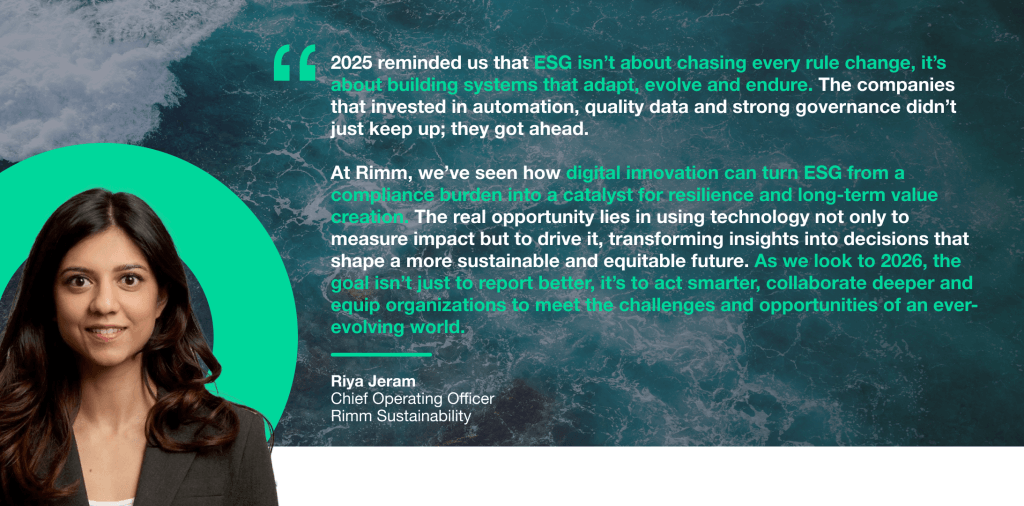
As 2026 approaches, the ESG conversation is maturing. The focus is shifting from disclosure volume to disclosure value, from reporting what companies do, to proving how it makes a difference.
Businesses that thrive in the next phase will share three traits: adaptability, accountability, and authenticity. They will see ESG not as a checklist, but as a compass, guiding smarter decisions, building stronger relationships, and ensuring business continuity in a volatile world.
At Rimm, we’re committed to helping organizations move from compliance to confidence. With the right data, tools, and mindset, sustainability leadership isn’t about following trends; it’s about setting them.
If you’re ready to lead with transparency and purpose, let’s take the next step together. Discover how technology-powered ESG reporting can unlock new opportunities in 2026 and beyond.
👉 Book a call with our team of experts here to get started on your journey!