
For many organisations, ESG reporting begins with a clear ambition. But translating that ambition into a credible, decision-ready report is where the real challenge lies. As sustainability expectations continue to evolve globally, leading organisations are moving beyond established ESG reporting practices to align with internationally recognised standards, such as the International Financial Reporting Standards. In Nigeria, the Financial Reporting Council (FRC) has mandated that sustainability-related financial disclosures be aligned with the IFRS Sustainability Disclosure Standards (IFRS S1 and IFRS S2), following Nigeria’s formal adoption roadmap issued in March 2024 and forward-looking companies like Guinness Nigeria are taking deliberate steps to strengthen the transparency, comparability and financial relevance of their disclosures. In this blog, we share how we have supported Nigeria’s leading Total Beverage Alcohol (TBA) Company, Guinness Nigeria, through its transition to the adoption of the IFRS Sustainability Disclosure Standards.
How Rimm Supported Guinness Nigeria
Guinness Nigeria’s journey reflects a reality faced by many leading businesses across Africa and beyond: increasing expectations around transparency, comparability and governance, paired with the need to bring teams up to speed quickly and confidently.
Rather than treating ESG reporting as a one-off compliance exercise, Guinness Nigeria approached IFRS alignment not just as a compliance requirement, but as a strategic opportunity to deepen integration between sustainability, risk management and long-term value creation.
To accelerate this ambition and ensure alignment with global best practices, Guinness Nigeria partnered with Rimm.
A Partnership Built Around Capacity Building, Not Just Technology
At Rimm, we believe successful ESG reporting is as much about people and process as it is about platforms. Our work with Guinness Nigeria focused on meeting the organisation where it was in its ESG journey, building internal capabilities and establishing systems for continuous improvement.
From the outset, the emphasis was on creating processes and systems that enable the organisation to continually enhance disclosures, year-on-year. Underpinning this was the need for capability building, ensuring teams understood not just what was required, but why it mattered and how to deliver it with confidence.
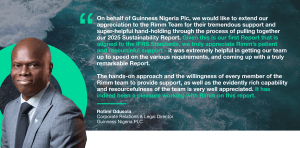
As Guinness Nigeria shared in its testimonial:
“Given this is our first Report that will be IFRS-aligned, we truly appreciated Rimm’s patient and resourceful support, which has been extremely helpful in getting our team up to speed on the various requirements for coming up with a truly remarkable Report.”
Creating a Clear, Structured Journey for Aligning ESG Disclosures with IFRS Requirements
One of the biggest barriers to effective ESG reporting is data fragmentation, with information spread across teams, formats, and systems, with limited visibility at the leadership level. This is felt strongly when considering the IFRS requirements; often, data points are owned by one department, but input is needed from multiple other departments in order to craft disclosures which are aligned with the expectations of the framework.
Combining Rimm’s myCSO platform with our in-house sustainability experts, Guinness Nigeria was able to have an organised, structured workflow built around the requirements of IFRS S1 and IFRS S2:
1. Education, Onboarding and Foundation Building
The journey began with education and onboarding. Working together, we discussed with the Guinness Nigeria Team the requirements of IFRS; the variety of departments that needed to be engaged for data collection, the new types of data points that should be disclosed and more importantly, how all these pieces fit together and would look in a final report. Significant planning was done to match departments to data points, assign data inputters and data validators within the myCSO platform, and to onboard teams effectively.
2. Assessing What Matters Most
A core principle of IFRS S1 and S2 is that sustainability disclosures are structured through the lens of risks and opportunities (R&Os) that could reasonably be expected to affect enterprise value. In our work with Guinness Nigeria, this meant moving beyond listing ESG activities and instead assessing how sustainability-related matters translate into financially relevant exposures and strategic upside. Under IFRS, governance, strategy, risk management, and metrics are all anchored to clearly defined R&Os — making their identification the foundation of credible reporting. Those R&Os, in turn, are grounded in a robust understanding of material topics. Through our platform, material sustainability topics are systematically identified and prioritised, generating a defensible materiality output that directly informs the sustainability-related risk and opportunity register. This creates a clear line of sight from material topic, to risk and opportunity, to disclosures, ensuring the resulting report is not just descriptive but IFRS-aligned and decision-useful.
3. Organised and Trackable Data Collection
Our platform enhanced the existing data collection process into a more structures and trackable system. Sustainability data was systemised through targeted assessments mapped directly to IFRS S1, IFRS S2 and the relevant SASB industry-specific metrics, ensuring coverage across general, climate-related and sector-specific disclosure requirements. Information was captured by reporting year and by business unit, creating a clear audit trail and enabling granular oversight.
Built-in filtering and progress-tracking tools allowed teams to monitor completion status in real time, quickly identify gaps, and prioritise follow-ups. Importantly, each question was supported by tailored guidance aligned to the technical requirements of IFRS, helping data owners provide responses that were not only complete but disclosure-ready.
4. Professional, IFRS-Aligned Reporting
Once data had been centralised and validated within the platform, we translated the aggregated outputs into a structured, IFRS-aligned ESG report anchored to the core disclosure pillars of governance, strategy, risk management, and metrics and targets. Rather than reproducing raw responses, we synthesised the information through the IFRS lens of sustainability-related risks and opportunities, ensuring a clear linkage between material topics, financial relevance, and performance indicators. Climate disclosures were aligned to IFRS S2 requirements, while industry-specific metrics were incorporated in line with SASB guidance to strengthen decision-usefulness and comparability. Gaps were transparently addressed, transition reliefs were appropriately applied, and narrative disclosures were refined to ensure technical accuracy and coherence. The result was robust, IFRS-aligned Sustainability Report anchored on governance, strategy, risk management and metrics and targets. The report not only meet global expectations but also strengthens transparency, enhance investor confidence and reflects Guinness Nigeria’s unique business context and sustainability journey.
As Guinness Nigeria noted:
“The hands-on approach and the willingness of every member of the Rimm team to provide support… has indeed been extremely helpful. It has been a pleasure working with Rimm on this report.”
Beyond the Report: Building for the Long Term
What makes this case study particularly powerful is that the value didn’t end after delivery of the final report. By combining education, collaboration and intelligent reporting tools, Guinness Nigeria built internal confidence, stronger processes and a foundation for continuous improvement.
This reflects a core principle at Rimm: we support organisations at every stage of their ESG journey, whether producing their first report, scaling mature programmes or embedding ESG into strategic decision-making.
Scaling Impact with Confidence
As ESG expectations continue to evolve, organisations need more than data; they need clarity, credibility and confidence.
Guinness Nigeria’s experience shows what’s possible when ESG reporting is approached as a partnership, supported by organised and trackable data collection and hands-on expertise.
At Rimm, we’re proud to work alongside organisations across Africa and beyond, helping them scale impact, strengthen trust and turn ESG ambition into meaningful action.
If you’re ready to move from ESG complexity to clarity, we’d love to support your journey. Reach out TODAY!