

Climate risk is no longer a distant scenario. It is operational, financial and systemic. From floods halting semiconductor production to heatwaves disrupting logistics corridors, extreme weather events are exposing vulnerabilities across global value chains. For years, climate risk modelling focused primarily on forecasting, analysing historical trends to estimate what might happen next. Today, that is no longer enough. Artificial intelligence is transforming climate risk from reactive prediction to proactive prevention. The shift is subtle but powerful: from identifying what went wrong, to anticipating what could go wrong and acting early enough to change the outcome. At Rimm, we see this shift every day. Through AI-driven analytics and predictive modelling, we are helping organisations turn complex climate and ESG data into decision-ready intelligence, strengthening resilience across operations, portfolios and supply chains. In this blog, we explore how AI is reshaping climate risk management, from detecting hidden vulnerabilities and enhancing ESG materiality assessments to enabling smarter capital allocation and more credible sustainability communication.
From Static Risk Maps to Dynamic Intelligence
Traditional climate modelling relies heavily on static datasets and long reporting cycles. Risk assessments are often annual exercises, valuable for disclosure, but limited for decision-making in fast-changing environments. AI changes the equation in three critical ways:
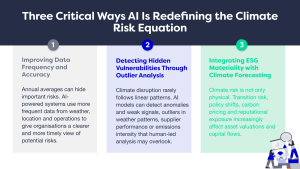
1. Detecting Hidden Vulnerabilities Through Outlier Analysis
Climate disruption rarely follows linear patterns. AI models can detect anomalies and weak signals, outliers in weather patterns, supplier performance or emissions intensity that human-led analysis may overlook.
For example, a supplier may appear operationally stable based on historical averages. However, AI-driven risk models can identify increasing volatility in regional precipitation patterns, linking it to potential production disruptions months in advance.
This ability to surface hidden correlations allows businesses to address vulnerabilities before they escalate into operational crises.
2. Improving Data Frequency and Accuracy
Annual averages can hide important risks. AI-powered systems use more frequent data from weather, location and operations to give organisations a clearer and more timely view of potential risks. Organisations can now ask:
- What is our 90-day disruption probability across Tier 2 suppliers?
- How will next quarter’s temperature anomalies affect energy demand and costs?
The shift toward real-time intelligence enables preventative mitigation, rerouting supply chains, adjusting inventory buffers, or reallocating capital before disruption materialises.
3. Integrating ESG Materiality with Climate Forecasting
Climate risk is not only physical. Transition risk, policy shifts, carbon pricing and reputational exposure increasingly affect asset valuations and capital flows.
AI enhances ESG materiality assessments by automatically identifying and categorising material topics based on industry categories, stakeholder expectations and regulatory developments. At Rimm, our automated materiality mapping and NLP-driven data scraping transform unstructured data into verified, structured insights.
By combining physical climate data with ESG performance indicators, organisations gain a more complete view of enterprise risk, linking environmental exposure to financial and reputational outcomes.
From Weather Prediction to Risk-Adjusted Strategy
Weather forecasting has long benefited from machine learning. Climate risk management is now following the same trajectory.
At Rimm, our Data Science team, led by Chief Data Scientist Dr Faddy Ardian, develops predictive models that forecast emissions scenarios, climate transition pathways and financial impacts.
But prediction alone does not create resilience. Prevention does. AI-powered climate intelligence supports:
Smarter Capital Allocation
When organisations can model transition risks up to 2050, assess financed emissions exposure, or quantify physical asset vulnerability, capital can be deployed more strategically.
Should a facility be retrofitted or relocated?
Which portfolio companies face escalating climate-adjusted cost of capital?
Where should resilience investments be prioritised?
Predictive modelling turns sustainability from a compliance function into a strategic capital allocation tool.
Risk-Adjusted Decision Making
By embedding ESG and climate intelligence into enterprise risk systems, companies can assess projects and investments through a climate-adjusted lens.
Rimm’s Data Suite, powered by over 26 million data points across 21,000+ companies globally, integrates AI-driven risk ratings, climate transition modelling (TR360) and sentiment analysis to provide forward-looking risk visibility.
The outcome is clarity: organisations can quantify downside exposure and upside opportunity simultaneously.
Translating Raw Data into Decision-Ready Insights
Data is abundant. Insight is scarce. Meteorological datasets, emissions disclosures, supply chain audits and regulatory updates generate enormous volumes of information. Without intelligent processing, this complexity creates paralysis.
Clients using Rimm’s AI-driven risk tools are transforming raw environmental and ESG data into actionable intelligence. Instead of static dashboards, they receive automated analytics, predictive alerts and scenario modelling that guide operational decisions and the results they are getting are:
- Reduced reporting timelines
- Enhanced risk visibility
- Clearer sustainability-driven decision-making
Climate resilience becomes embedded within business strategy, not confined to annual disclosures.
Technology That Enables, Not Replaces
At Rimm, we believe technology should empower sustainability teams—not replace them. Sustainability is complex, with no single “source of truth,” which is why our AI-enabled tools are built to be flexible and adaptable to each organisation’s industry, geography, and level of maturity.
AI is accelerating a critical shift—from reactive forecasting to proactive prevention. It helps organisations identify hidden vulnerabilities, improve the timing and accuracy of decisions, integrate ESG priorities, and allocate capital more effectively.
Our mission is to make sustainability actionable for every organisation, using technology, data, and AI-driven insights. Because resilience isn’t built by reacting to disruption—it’s built by preventing it.
If you’re ready to move from ESG complexity to clarity, we’d love to support your journey. Reach out today.