
Reflections from the SFi Impact Summit, Hong Kong By Ravi Chidambaram, Chief Executive Officer, Rimm Sustainability and Bonnie Chiu, Managing Director, The Social Investment Consultancy (TSIC)
At the SFi Impact Summit 2026 in Hong Kong, leaders from across finance, philanthropy, government, sustainability and impact investing came together to discuss one of the region’s most pressing challenges: how do we move from isolated success stories to impact at meaningful scale?
The summit explored themes ranging from sustainable finance and climate innovation to blended capital and ecosystem building. Yet across these conversations, a common thread emerged. The challenge is no longer a lack of capital, technology or ambition, but how these elements are connected and mobilised to create lasting, systemic change.
Throughout the event, we found ourselves returning to the same question: what is preventing impact from scaling across Asia at the pace the region needs?
The region has no shortage of opportunity. Capital is growing, technology is advancing and awareness of environmental and social challenges continues to increase. Yet many promising solutions struggle to move beyond pilot stages, while significant pools of capital remain disconnected from the opportunities where they could create the greatest impact.
Coming from different vantage points, one focused on sustainability technology and systems change, the other on impact investing and catalytic capital, we arrived at a remarkably similar conclusion. The missing ingredient is not capital or innovation themselves. It is the connective layer between them: the structures, incentives and conviction required to turn potential into scale.
Where Climate Solutions Scale, And Where They Stall
The climate solutions that scale across Asia are the ones that make financial sense: cost-effective, with a tangible return on investment. In the absence of strong regulatory pressure, most climate technology in the region is adopted on a straightforward cost-versus-benefit basis, which is why renewables, EV infrastructure and some waste solutions move from pilot to deployment, carried by a clear financial case, while those that depend on policy signals which have not yet arrived tend to stall.
The biggest misconception is that the barrier is a shortage of technology or finance, when in fact both exist at scale. The technology is mature and the money is there; what is missing is the pull that turns availability into adoption.
“Asia does not have a climate technology problem. It has an adoption problem. The solutions increasingly exist; the challenge is creating the incentives and structures that enable them to scale.”
— Ravi Chidambaram, CEO & Founder, Rimm Sustainability
Why Blended Finance Is Still Misunderstood
On the capital side, the same pattern appears in how we think about blended finance, which is still too often treated as a niche tool for large infrastructure deals or traditional development finance. That is where it was most visible and most institutionally developed, so the association stuck.
But blended finance is not a sector. It is a way of structuring capital, and it works wherever there is a mismatch between strong social or environmental outcomes and weak standalone financial returns. We are now seeing philanthropic capital move into genuinely catalytic positions, taking first loss or concessionary risk to de-risk an opportunity and bring in much larger pools of commercial capital, which changes how capital is mobilised, not just how projects get funded.
The misunderstanding that persists is that it is too complex, or only for sophisticated institutions, when in reality, once you understand the underlying logic, it is remarkably adaptable across domestic and international contexts and across the whole spectrum of capital. The opportunity is to demystify the structures so more organisations can use them deliberately to scale impact.
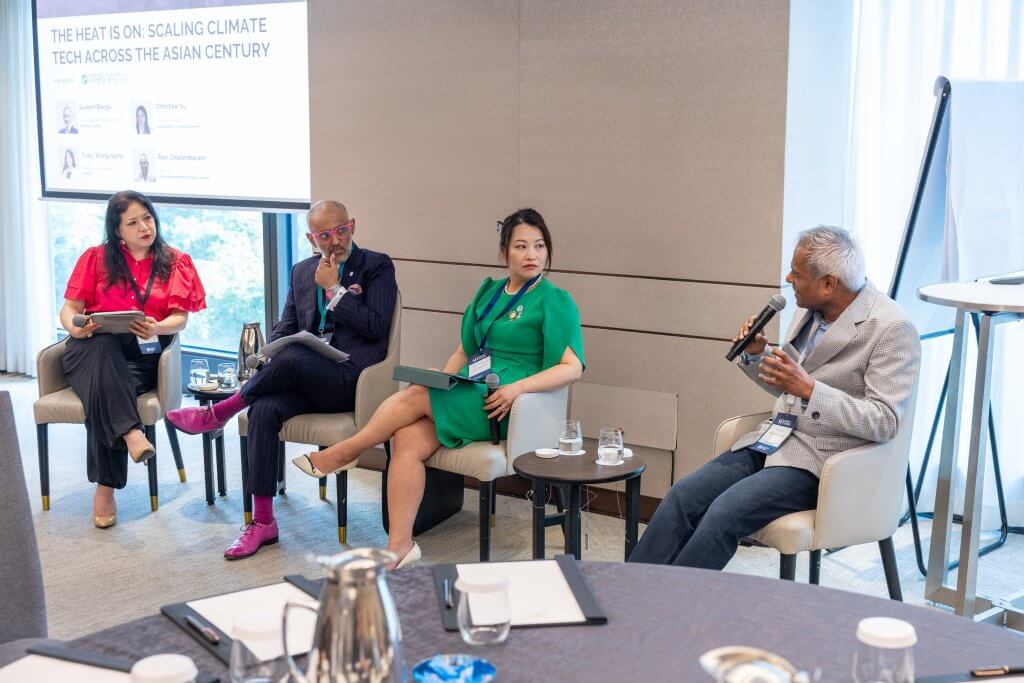
Ravi speaking on a panel discussing scaling climate tech across Asia, at the Sustainable Finance Initiative in Hopewell hotel, Hong Kong, China, on 3 June 2026. Photo by Daniel Murray/Daniel Murray Studios.
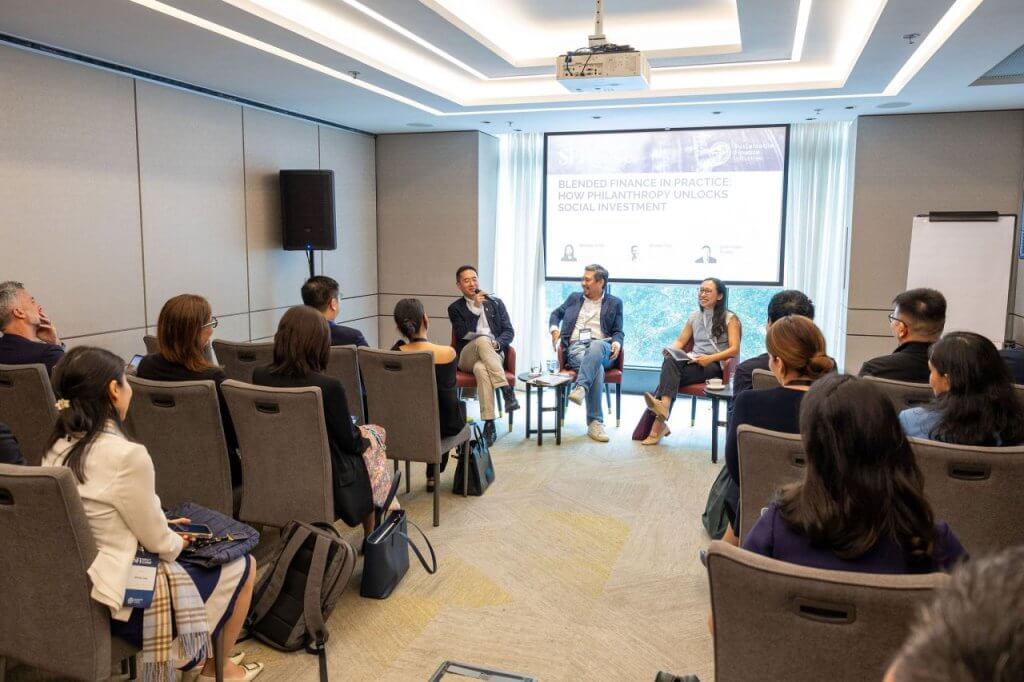
Bonnie speaking on a panel discussing blended finance, and how philanthropy unlocks social investment, at the Sustainable Finance Initiative in Hopewell hotel, Hong Kong, China, on 3 June 2026. Photo by Daniel Murray/Daniel Murray Studios.
From Giving To Catalysing
That asks something of philanthropy in particular, because the shift from grant-giving to a catalytic role is fundamentally one of mindset.
Traditional grant-making is problem-led: you identify an issue and fund an intervention to address it. A catalytic approach is ecosystem-led, paying less attention to isolated problems and more to the health of the systems and organisations needed to solve them over time.
The harder shift is about returns. In a blended structure, philanthropic capital often sits beside commercial capital that earns a return, while philanthropy is concessional by design, and placed side by side that can feel unequal. But the goal is not parity of financial return; it is the greatest possible impact leverage. Used well, catalytic philanthropy makes the entire capital stack work harder and extends the reach of every philanthropic contribution.
“Catalytic capital is not about replacing traditional philanthropy. It is about using every dollar more intentionally to unlock larger pools of capital and create lasting systems change.”
— Bonnie Chiu, Managing Director, TSIC
The Shared Diagnosis
Which brings us to the question we were both asked: what is currently preventing impact from scaling across Asia at the pace the region needs? Our answers came from different angles but pointed the same way. Part of it is regulation, since without incentives or penalties strong enough to drive adoption, climate solutions advance wherever the financial case is clear and stall wherever it is not. The other part is capital, or rather the way capital is deployed, because the constraint is not that Asia lacks capital but that too little of it is deployed with conviction toward systemic outcomes. The region has seen extraordinary wealth creation, yet much of it, philanthropic capital especially, is still put to work in a traditional, output-focused way, funding direct services rather than the system-level constraints beneath them, which leaves the pipeline of catalytic, system-oriented capital thin.
Put the two together and the missing layer comes into focus: the technology and the capital both exist, but what remains underdeveloped is everything between them, the incentives that make adoption rational, the structures that move money toward risk, and the conviction to fund systems rather than symptoms.
None of this is a reason for pessimism; it is simply a map of where the work lies. Asia is not short of capital or capability, and the next phase of growth depends on building that connective layer, moving from a logic of immediate outputs to one of system change, and being willing to deploy both capital and policy with far more conviction. That is the work we are both committed to, and it feels more possible now than it ever has.
Building the Missing Layer Together
The themes discussed throughout the SFi Impact Summit are also reflected in our newly announced strategic partnership between Rimm Sustainability and The Social Investment Consultancy (TSIC).
While Rimm brings advanced sustainability technology, ESG data intelligence and impact measurement capabilities, TSIC contributes deep expertise in impact strategy, social investment and blended finance. Together, the partnership is designed to help organisations bridge the gap between sustainability ambition and implementation.
By combining technology, data, impact measurement and catalytic capital expertise, we aim to support businesses, investors, governments, foundations and philanthropic organisations in building stronger sustainability and impact ecosystems across Asia and beyond.
At its core, the partnership reflects a shared belief: meaningful change happens when capital, data and decision-making are connected. Whether through better impact measurement, stronger sustainability intelligence or more innovative financing structures, the objective remains the same—to create the infrastructure that allows impact to scale.
The conversations at the SFi Impact Summit reinforced why this work matters. The solutions already exist. The opportunity now is to build the connective tissue that enables them to deliver impact at the scale the world requires.
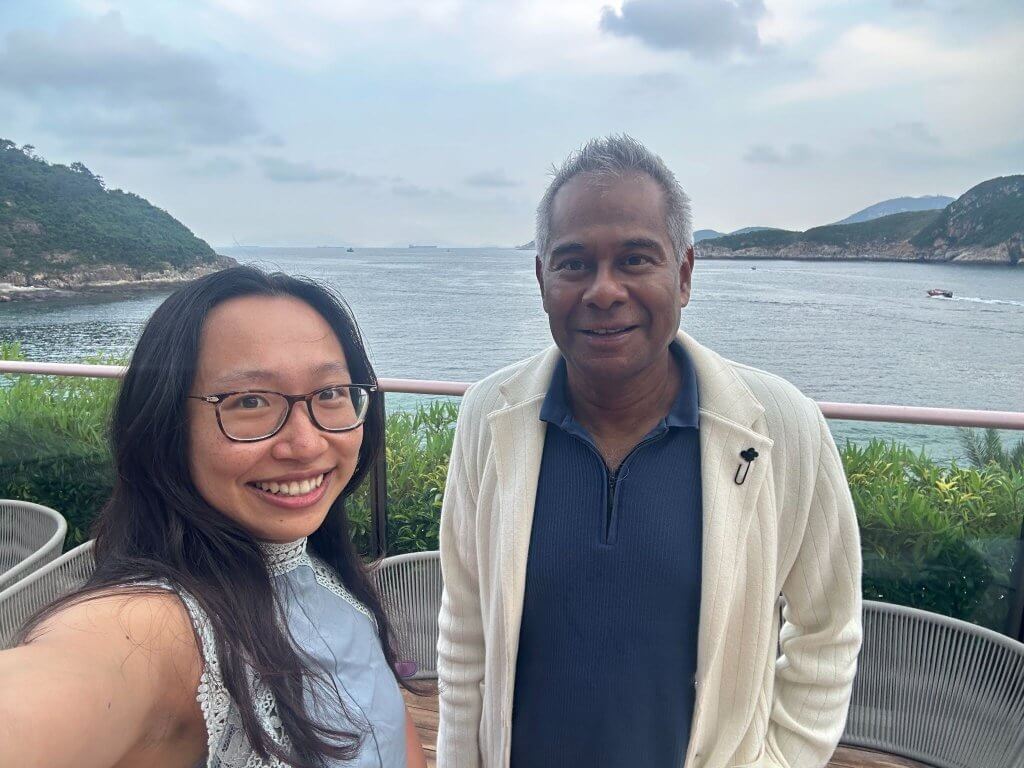
About the Authors
Ravi Chidambaram is CEO & Founder of Rimm Sustainability, a sustainability technology company helping organisations turn ESG and impact data into measurable business value through AI-powered solutions, analytics and reporting platforms. Ravi brings more than 25 years of experience across finance, technology and sustainability, and serves as an Adjunct Professor of Sustainability.
Bonnie Chiu is Managing Director of The Social Investment Consultancy (TSIC), a global consultancy focused on impact strategy, social investment and blended finance. Bonnie works with corporations, foundations, family offices and investors to design solutions that deliver measurable social and environmental impact while strengthening long-term ecosystem outcomes.