AI and Climate Risk: From Prediction to Prevention

Climate risk is no longer a distant scenario. It is operational, financial and systemic. From floods halting semiconductor production to heatwaves disrupting logistics corridors, extreme weather events are exposing vulnerabilities across global value chains. For years, climate risk modelling focused primarily on forecasting, analysing historical trends to estimate what might happen next. Today, that is no longer enough. Artificial intelligence is transforming climate risk from reactive prediction to proactive prevention. The shift is subtle but powerful: from identifying what went wrong, to anticipating what could go wrong and acting early enough to change the outcome. At Rimm, we see this shift every day. Through AI-driven analytics and predictive modelling, we are helping organisations turn complex climate and ESG data into decision-ready intelligence, strengthening resilience across operations, portfolios and supply chains. In this blog, we explore how AI is reshaping climate risk management, from detecting hidden vulnerabilities and enhancing ESG materiality assessments to enabling smarter capital allocation and more credible sustainability communication.

From Static Risk Maps to Dynamic Intelligence

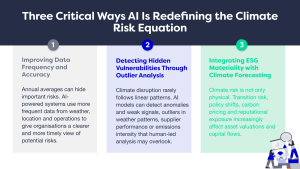
Traditional climate modelling relies heavily on static datasets and long reporting cycles. Risk assessments are often annual exercises, valuable for disclosure, but limited for decision-making in fast-changing environments. AI changes the equation in three critical ways:

1. Detecting Hidden Vulnerabilities Through Outlier Analysis

Climate disruption rarely follows linear patterns. AI models can detect anomalies and weak signals, outliers in weather patterns, supplier performance or emissions intensity that human-led analysis may overlook.

For example, a supplier may appear operationally stable based on historical averages. However, AI-driven risk models can identify increasing volatility in regional precipitation patterns, linking it to potential production disruptions months in advance.

This ability to surface hidden correlations allows businesses to address vulnerabilities before they escalate into operational crises.

2. Improving Data Frequency and Accuracy

Annual averages can hide important risks. AI-powered systems use more frequent data from weather, location and operations to give organisations a clearer and more timely view of potential risks. Organisations can now ask:

  • What is our 90-day disruption probability across Tier 2 suppliers?
  • How will next quarter’s temperature anomalies affect energy demand and costs?

The shift toward real-time intelligence enables preventative mitigation, rerouting supply chains, adjusting inventory buffers, or reallocating capital before disruption materialises.

3. Integrating ESG Materiality with Climate Forecasting

Climate risk is not only physical. Transition risk, policy shifts, carbon pricing and reputational exposure increasingly affect asset valuations and capital flows.

AI enhances ESG materiality assessments by automatically identifying and categorising material topics based on industry categories, stakeholder expectations and regulatory developments. At Rimm, our automated materiality mapping and NLP-driven data scraping transform unstructured data into verified, structured insights.

By combining physical climate data with ESG performance indicators, organisations gain a more complete view of enterprise risk, linking environmental exposure to financial and reputational outcomes.
From Weather Prediction to Risk-Adjusted Strategy

Weather forecasting has long benefited from machine learning. Climate risk management is now following the same trajectory.

At Rimm, our Data Science team, led by Chief Data Scientist Dr Faddy Ardian, develops predictive models that forecast emissions scenarios, climate transition pathways and financial impacts.

But prediction alone does not create resilience. Prevention does. AI-powered climate intelligence supports:

Smarter Capital Allocation

When organisations can model transition risks up to 2050, assess financed emissions exposure, or quantify physical asset vulnerability, capital can be deployed more strategically.

Should a facility be retrofitted or relocated?
Which portfolio companies face escalating climate-adjusted cost of capital?
Where should resilience investments be prioritised?

Predictive modelling turns sustainability from a compliance function into a strategic capital allocation tool.

Risk-Adjusted Decision Making

By embedding ESG and climate intelligence into enterprise risk systems, companies can assess projects and investments through a climate-adjusted lens.

Rimm’s Data Suite, powered by over 26 million data points across 21,000+ companies globally, integrates AI-driven risk ratings, climate transition modelling (TR360) and sentiment analysis to provide forward-looking risk visibility.

The outcome is clarity: organisations can quantify downside exposure and upside opportunity simultaneously.

Translating Raw Data into Decision-Ready Insights

Data is abundant. Insight is scarce. Meteorological datasets, emissions disclosures, supply chain audits and regulatory updates generate enormous volumes of information. Without intelligent processing, this complexity creates paralysis.

Clients using Rimm’s AI-driven risk tools are transforming raw environmental and ESG data into actionable intelligence. Instead of static dashboards, they receive automated analytics, predictive alerts and scenario modelling that guide operational decisions and the results they are getting are:

  • Reduced reporting timelines
  • Enhanced risk visibility
  • Clearer sustainability-driven decision-making

Climate resilience becomes embedded within business strategy, not confined to annual disclosures.

Technology That Enables, Not Replaces

At Rimm, we believe technology should empower sustainability teams—not replace them. Sustainability is complex, with no single “source of truth,” which is why our AI-enabled tools are built to be flexible and adaptable to each organisation’s industry, geography, and level of maturity.

AI is accelerating a critical shift—from reactive forecasting to proactive prevention. It helps organisations identify hidden vulnerabilities, improve the timing and accuracy of decisions, integrate ESG priorities, and allocate capital more effectively.

Our mission is to make sustainability actionable for every organisation, using technology, data, and AI-driven insights. Because resilience isn’t built by reacting to disruption—it’s built by preventing it.

If you’re ready to move from ESG complexity to clarity, we’d love to support your journey. Reach out today.
From Established Reporting to IFRS Alignment: How Guinness Nigeria is Strengthening ESG Disclosures and Compliance

For many organisations, ESG reporting begins with a clear ambition. But translating that ambition into a credible, decision-ready report is where the real challenge lies. As sustainability expectations continue to evolve globally, leading organisations are moving beyond established ESG reporting practices to align with internationally recognised standards, such as the International Financial Reporting Standards. In Nigeria, the Financial Reporting Council (FRC) has mandated that sustainability-related financial disclosures be aligned with the IFRS Sustainability Disclosure Standards (IFRS S1 and IFRS S2), following Nigeria’s formal adoption roadmap issued in March 2024 and forward-looking companies like Guinness Nigeria are taking deliberate steps to strengthen the transparency, comparability and financial relevance of their disclosures. In this blog, we share how we have supported Nigeria’s leading Total Beverage Alcohol (TBA) Company, Guinness Nigeria, through its transition to the adoption of the IFRS Sustainability Disclosure Standards.

How Rimm Supported Guinness Nigeria 

Guinness Nigeria’s journey reflects a reality faced by many leading businesses across Africa and beyond: increasing expectations around transparency, comparability and governance, paired with the need to bring teams up to speed quickly and confidently.

Rather than treating ESG reporting as a one-off compliance exercise, Guinness Nigeria approached IFRS alignment not just as a compliance requirement, but as a strategic opportunity to deepen integration between sustainability, risk management and long-term value creation.

To accelerate this ambition and ensure alignment with global best practices, Guinness Nigeria partnered with Rimm.

A Partnership Built Around Capacity Building, Not Just Technology

At Rimm, we believe successful ESG reporting is as much about people and process as it is about platforms. Our work with Guinness Nigeria focused on meeting the organisation where it was in its ESG journey, building internal capabilities and establishing systems for continuous improvement.

From the outset, the emphasis was on creating processes and systems that enable the organisation to continually enhance disclosures, year-on-year. Underpinning this was the need for capability building, ensuring teams understood not just what was required, but why it mattered and how to deliver it with confidence.

As Guinness Nigeria shared in its testimonial:

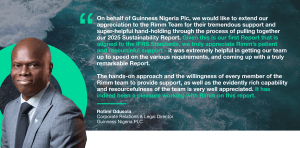
“Given this is our first Report that will be IFRS-aligned, we truly appreciated Rimm’s  patient and resourceful support, which has been extremely helpful in getting our team up to speed on the various requirements for coming up with a truly remarkable Report.”

Creating a Clear, Structured Journey for Aligning ESG Disclosures with IFRS Requirements

One of the biggest barriers to effective ESG reporting is data fragmentation, with information spread across teams, formats, and systems, with limited visibility at the leadership level. This is felt strongly when considering the IFRS requirements; often, data points are owned by one department, but input is needed from multiple other departments in order to craft disclosures which are aligned with the expectations of the framework.  

Combining Rimm’s myCSO platform with our in-house sustainability experts, Guinness Nigeria was able to have an organised, structured workflow built around the requirements of IFRS S1 and IFRS S2:

1. Education, Onboarding and Foundation Building

The journey began with education and onboarding. Working together, we discussed with the Guinness Nigeria Team the requirements of IFRS; the variety of departments that needed to be engaged for data collection, the new types of data points that should be disclosed and more importantly, how all these pieces fit together and would look in a final report. Significant planning was done to match departments to data points, assign data inputters and data validators within the myCSO platform, and to onboard teams effectively. 

2. Assessing What Matters Most

A core principle of IFRS S1 and S2 is that sustainability disclosures are structured through the lens of risks and opportunities (R&Os) that could reasonably be expected to affect enterprise value. In our work with Guinness Nigeria, this meant moving beyond listing ESG activities and instead assessing how sustainability-related matters translate into financially relevant exposures and strategic upside. Under IFRS, governance, strategy, risk management, and metrics are all anchored to clearly defined R&Os — making their identification the foundation of credible reporting. Those R&Os, in turn, are grounded in a robust understanding of material topics. Through our platform, material sustainability topics are systematically identified and prioritised, generating a defensible materiality output that directly informs the sustainability-related risk and opportunity register. This creates a clear line of sight from material topic, to risk and opportunity, to disclosures, ensuring the resulting report is not just descriptive but IFRS-aligned and decision-useful.

3. Organised and Trackable Data Collection 

Our platform enhanced the existing data collection process into a more structures and trackable system. Sustainability data was systemised through targeted assessments mapped directly to IFRS S1, IFRS S2 and the relevant SASB industry-specific metrics, ensuring coverage across general, climate-related and sector-specific disclosure requirements. Information was captured by reporting year and by business unit, creating a clear audit trail and enabling granular oversight. 

Built-in filtering and progress-tracking tools allowed teams to monitor completion status in real time, quickly identify gaps, and prioritise follow-ups. Importantly, each question was supported by tailored guidance aligned to the technical requirements of IFRS, helping data owners provide responses that were not only complete but disclosure-ready.

4. Professional, IFRS-Aligned Reporting

Once data had been centralised and validated within the platform, we translated the aggregated outputs into a structured, IFRS-aligned ESG report anchored to the core disclosure pillars of governance, strategy, risk management, and metrics and targets. Rather than reproducing raw responses, we synthesised the information through the IFRS lens of sustainability-related risks and opportunities, ensuring a clear linkage between material topics, financial relevance, and performance indicators. Climate disclosures were aligned to IFRS S2 requirements, while industry-specific metrics were incorporated in line with SASB guidance to strengthen decision-usefulness and comparability. Gaps were transparently addressed, transition reliefs were appropriately applied, and narrative disclosures were refined to ensure technical accuracy and coherence. The result was robust, IFRS-aligned Sustainability Report anchored on governance, strategy, risk management and metrics and targets. The report not only meet global expectations but also strengthens transparency, enhance investor confidence and reflects Guinness Nigeria’s unique business context and sustainability journey.

As Guinness Nigeria noted:

“The hands-on approach and the willingness of every member of the Rimm team to provide support… has indeed been extremely helpful. It has been a pleasure working with Rimm on this report.”

Beyond the Report: Building for the Long Term

What makes this case study particularly powerful is that the value didn’t end after delivery of the final report. By combining education, collaboration and intelligent reporting tools, Guinness Nigeria built internal confidence, stronger processes and a foundation for continuous improvement.

This reflects a core principle at Rimm: we support organisations at every stage of their ESG journey, whether producing their first report, scaling mature programmes or embedding ESG into strategic decision-making.

Scaling Impact with Confidence

As ESG expectations continue to evolve, organisations need more than data; they need clarity, credibility and confidence.

Guinness Nigeria’s experience shows what’s possible when ESG reporting is approached as a partnership, supported by organised and trackable data collection and hands-on expertise.

At Rimm, we’re proud to work alongside organisations across Africa and beyond, helping them scale impact, strengthen trust and turn ESG ambition into meaningful action.

If you’re ready to move from ESG complexity to clarity, we’d love to support your journey. Reach out TODAY!

Spreadsheets to Strategy: How AI Is Reshaping ESG Reporting in 2026

For over a decade, spreadsheets have been the backbone of ESG reporting. They are accessible, familiar and flexible enough to capture early sustainability metrics. But by 2026, the By 2026, the constraints of this approach are becoming more visible as reporting expectations mature. ESG data is now broader, deeper and more interconnected than ever. It spans emissions across value chains, workforce metrics across regions, governance structures, policies, risks and forward-looking transition plans. Managing this level of complexity in spreadsheets is not only inefficient, it’s also risky. According to a recent global sustainability survey by a leading professional services firm, over 60% of companies cited data inconsistency and manual error as their biggest ESG reporting challenge, while nearly 70% said ESG reporting consumes more internal resources than financial reporting. These pressures are driving a fundamental shift: from manual data handling to intelligent systems built for scale. In this blog, we explore how artificial intelligence is reshaping ESG reporting in 2026, why this shift matters and how organisations can move from spreadsheet dependency to strategic advantage.

The ESG Reporting Reality in 2026

The ESG landscape in 2026 is defined by contradiction. Regulatory requirements continue to evolve unevenly across regions worldwide, yet stakeholder expectations remain consistently high. Investors still demand decision-useful sustainability data. Boards expect clearer insight into ESG risks and opportunities. Employees and customers want transparency backed by evidence.

At the same time, reporting frameworks have become more sophisticated, with greater emphasis on governance, consistency and linkage to financial performance. This has raised the bar for data quality and narrative coherence.

Spreadsheets struggle under these demands. They are static, difficult to audit and heavily dependent on manual input. Version control issues, formula errors and inconsistent assumptions create uncertainty, exactly what ESG reporting is meant to reduce.

This is where AI enters the picture, not as a replacement for expertise, but as a powerful enabler. By automating data extraction, validating inputs in real time, mapping disclosures across frameworks and identifying gaps or inconsistencies early, AI significantly reduces manual effort, duplication and reporting risk.

It transforms fragmented spreadsheets into structured, decision-ready intelligence, allowing teams to focus less on chasing data and more on analysing insights, strengthening governance and driving strategic impact.

What AI Really Changes in ESG Reporting

AI streamlines and strengthens the entire ESG reporting process. By automating data collection, validating inputs in real time, mapping disclosures across multiple frameworks and flagging gaps early, it significantly reduces manual effort and reporting risk. Instead of teams spending weeks consolidating spreadsheets, AI enables structured, audit-ready workflows that improve accuracy, consistency and speed. The result is not just efficiency, but clearer insights, stronger governance and more confident, decision-ready reporting.

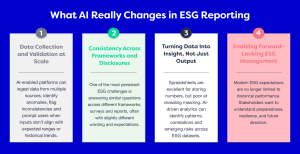
In ESG reporting, AI’s impact is most visible across four critical areas:

1. Data Collection and Validation at Scale: AI-enabled platforms can ingest data from multiple sources, identify anomalies, flag inconsistencies and prompt users when inputs don’t align with expected ranges or historical trends. This dramatically improves data reliability while reducing manual review time.

By the end of 2025, organisations using automated validation tools reported up to 40% fewer data errors compared to spreadsheet-based processes, according to enterprise software benchmarks.

2. Consistency Across Frameworks and Disclosures: One of the most persistent ESG challenges is answering similar questions across different frameworks, surveys and reports, often with slightly different wording and expectations.

AI can recognise overlaps, map disclosures across standards and ensure consistency in responses. This not only reduces duplication but also strengthens credibility by ensuring that narratives align across reports, investor questionnaires and regulatory filings.

3. Turning Data Into Insight, Not Just Output: Spreadsheets are excellent for storing numbers, but poor at revealing meaning. AI-driven analytics can identify patterns, correlations and emerging risks across ESG datasets.

For example, AI can highlight how changes in supplier emissions affect overall climate risk, or how workforce indicators correlate with safety incidents or attrition trends. These insights enable leadership teams to act earlier and more strategically.

4. Enabling Forward-Looking ESG Management: Modern ESG expectations are no longer limited to historical performance. Stakeholders want to understand preparedness, resilience, and future direction.

AI supports scenario analysis, trend forecasting and the testing of assumptions, helping organisations explore how ESG risks and opportunities may evolve under different conditions. This moves ESG reporting from backwards-looking disclosure to forward-looking strategy.

From Reporting Burden to Strategic Capability

Perhaps the most significant shift AI enables is cultural.

When ESG reporting is manual and spreadsheet-driven, it is often perceived as a burden, time-consuming, repetitive and disconnected from business value. When AI automates low-value tasks and enhances insight, ESG becomes a source of intelligence.

Recent research from global investment institutions shows that companies integrating advanced analytics into sustainability reporting are twice as likely to link ESG performance to capital allocation and strategic planning. This signals a clear trend: ESG data is becoming part of core decision-making.

How Rimm Is Supporting the Shift From Spreadsheets to Strategy

At Rimm, we see AI as an enabler of clarity, confidence and control. Our platform is designed to help organisations replace fragmented spreadsheet processes with structured, intelligent ESG management.

By embedding AI into data collection, validation, disclosure mapping and analytics, we help clients reduce reporting risk while increasing strategic value. Teams spend less time reconciling numbers and more time understanding what the data means for performance, resilience and growth.

Across regions and industries, organisations using Rimm are building ESG systems that scale, supporting evolving requirements without reinventing processes every reporting cycle.

What ESG Reporting Looks Like Going Forward

In 2026, the question is no longer whether ESG reporting should be automated, but how intelligently it should be done.

Spreadsheets may still have a role at the margins, but they are no longer the engine of sustainable reporting. AI-enabled platforms are becoming the new foundation, supporting accuracy, insight and strategic alignment.

The organisations that thrive in this environment will be those that treat ESG data not as a static record, but as a living asset, one that informs decisions, builds trust and strengthens long-term value.

At Rimm, we believe the future of ESG reporting lies at the intersection of technology and expertise and that future has already begun. Our team of experts is always ready to support that journey 👉🏾 Reach out today HERE

Impact Beyond Disclosure: Building Trust Through Portfolio and Group-Level ESG Reporting

For years, ESG reporting has been treated as a fragmented exercise. Individual entities report in isolation, metrics are collected inconsistently, and sustainability narratives rarely connect across a group or portfolio. The result? Disclosures that technically meet requirements but fail to answer the questions stakeholders actually care about: How resilient is this organisation as a whole? Where are the risks concentrated? And how is sustainability performance improving over time? In recent times, that approach is rapidly losing relevance. As investors, boards and employees demand clearer insight into how organisations manage sustainability across complex structures, consolidated ESG reporting is emerging as a critical trust-building tool. It shifts the conversation from scattered compliance to coherent strategy. In this blog, we explore why portfolio and group-level ESG reporting matters more than ever, how it strengthens governance and accountability and what organisations can do to turn consolidated reporting into a strategic advantage.

From Fragmented Compliance to Consolidated Strategy

The early years of ESG reporting were largely reactive. Organisations responded to questionnaires, ratings agencies and regulatory requirements as they arose, often without a unifying framework. This was particularly true for investment firms, holding companies and diversified groups, where each subsidiary or portfolio company followed its own approach to sustainability.

Today, that fragmentation creates real risk. Without consolidation, leadership teams struggle to see the full picture. Emissions may be reduced in one entity while rising in another. Workforce risks may be well-managed locally but poorly governed at the group level. And governance practices may vary widely, making oversight inconsistent and accountability unclear.

Consolidated ESG reporting addresses this challenge head-on. By bringing environmental, social, and governance data together at the portfolio or group level, organisations can assess performance holistically, identify systemic risks and set clear priorities. It also allows sustainability to be managed with the same discipline as financial performance, something investors increasingly expect.

Why Group-Level Reporting Builds Trust

Trust is built on clarity and consistency. Stakeholders want confidence that sustainability commitments are not limited to individual success stories, but are embedded across the organisation.

For investors, consolidated ESG reporting provides comparability. It allows them to understand how different entities within a portfolio perform against shared benchmarks, how risks are distributed and how capital allocation decisions align with sustainability objectives. For boards, it strengthens oversight by enabling consistent governance structures, policies and performance indicators across the group. For employees, it reinforces credibility, showing that sustainability values apply everywhere, not selectively.

In practice, consolidated reporting also reduces the noise created by multiple, disconnected disclosures. Instead of explaining sustainability performance entity by entity, organisations can tell a clearer, more strategic story about progress, challenges and long-term direction.

The Role of Global Frameworks in Credible Consolidation

Consolidation alone is not enough. To be meaningful, group-level ESG reporting must be anchored in recognised frameworks that ensure consistency and credibility.

Aligning disclosures with global frameworks such as the SDGs and regionally relevant initiatives like the ESG Disclosure and Classification Initiative (EDCI) helps organisations speak a common language. It improves comparability across portfolio companies, enhances alignment with investor expectations and reduces the risk of greenwashing by grounding narratives in established standards.

Framework alignment also provides structure. It guides organisations on what to measure, how to interpret results and how to connect sustainability performance to broader economic and societal outcomes. When applied at the group level, these frameworks become powerful tools for governance, enabling leadership teams to track progress against shared goals rather than disconnected metrics.

GLy Capital: Turning Consolidation Into Clarity

GLy Capital’s journey offers a compelling example of how consolidated ESG reporting can move beyond disclosure to real impact. Having reported with Rimm for the past three years, GLy has progressively strengthened its approach to sustainability reporting at the portfolio level.

In its 2024 consolidated sustainability report, GLy aligned emissions, workforce and governance data across its portfolio companies to global frameworks, including the SDGs and EDCI. This approach created a consistent baseline for performance measurement, allowing leadership to compare entities more effectively and identify both risks and opportunities across the portfolio.

The benefits were tangible. Board-level oversight improved as sustainability data became more structured and decision-useful. Portfolio companies gained clearer guidance on expectations and performance benchmarks. And trust with investors and employees deepened, supported by transparent, comparable and credible disclosures.

Rather than treating ESG as a reporting obligation, GLy used consolidation as a governance tool, strengthening accountability and reinforcing sustainability as a core part of its investment strategy.

Practical Steps to Strengthen Portfolio and Group-Level ESG Reporting

For organisations looking to follow a similar path, a few practical principles can make a significant difference:

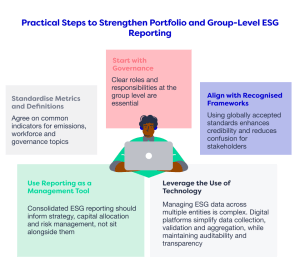
Start with Governance: Clear roles and responsibilities at the group level are essential. Define who owns the ESG strategy, who validates data and how performance is reviewed across entities.

Standardise Metrics and Definitions: Agree on common indicators for emissions, workforce and governance topics. This ensures data can be aggregated meaningfully without losing context.

Align with Recognised Frameworks: Using globally accepted standards enhances credibility and reduces confusion for stakeholders reviewing consolidated disclosures.

Use Reporting as a Management Tool: Consolidated ESG reporting should inform strategy, capital allocation and risk management, not sit alongside them.

Leverage Technology: Managing ESG data across multiple entities is complex. Digital platforms simplify data collection, validation and aggregation, while maintaining auditability and transparency.

How Rimm Supports Group-Level ESG Reporting
At Rimm, we work with investment firms, holding companies and complex organisations to transform ESG reporting from a fragmented process into a coherent, portfolio-wide capability. Our platform enables organisations to collect consistent data across entities, align disclosures with global frameworks and generate consolidated reports that support both transparency and strategic decision-making.

By combining structured data management with clear reporting outputs, we help clients move beyond disclosure toward governance, accountability and long-term value creation. GLy Capital’s three-year reporting journey with Rimm reflects what’s possible when consolidation is approached with clarity, consistency and purpose.

Looking Ahead: Reporting as a Trust-Building Asset

In a world of heightened scrutiny and complex organisational structures, consolidated ESG reporting is no longer optional. It is a signal of maturity, discipline and long-term thinking.

Organisations that invest in group-level ESG reporting are not just improving compliance; they are building trust, strengthening governance and creating a foundation for sustainable growth. The question is no longer whether to consolidate, but how effectively it is done.

At Rimm, we believe that when ESG reporting reflects the full picture, it becomes more than disclosure. It becomes a strategic asset.

If you’re ready to strengthen trust through portfolio and group-level ESG reporting, we’re here to help. Let’s take the next step together 👉🏾 Reach out HERE

ESG at a Crossroads: 2026 Trends and Insights for Navigating a Shifting Sustainability Landscape

As 2026 begins, the ESG conversation feels markedly different from just a few years ago. The urgency is still there, but it’s more focused, more disciplined and far more strategic. Businesses are no longer asking whether ESG matters. Instead, they’re asking how to do it well in a world where regulations evolve unevenly, scrutiny is constant and expectations continue to rise. The closing months of 2025 made one thing clear: sustainability has entered a new phase. ESG is no longer driven solely by regulatory pressure or reputational risk. It is increasingly shaped by enterprise value, operational resilience and long-term competitiveness. In this blog, we explore the most important ESG trends defining 2026 and how organisations can stay ahead in a shifting sustainability landscape.

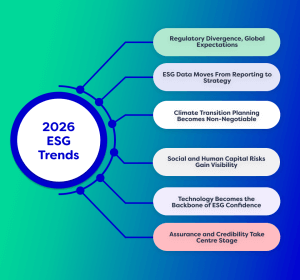
Trend 1: Regulatory Divergence, Global Expectations

By Q4 2025, it became evident that ESG regulation is no longer moving in a single direction. Some jurisdictions accelerated alignment with global standards such as IFRS Sustainability Disclosure Standards, while others slowed or re-prioritised mandatory requirements. This divergence has created complexity, but also clarity.

What hasn’t changed is stakeholder expectation. Investors, lenders, customers and partners continue to demand decision-useful, comparable sustainability information. Late-2025 investor sentiment surveys consistently showed that ESG data remains central to risk assessment and capital allocation, regardless of whether disclosure is legally required.

For businesses in 2026, the implication is clear: compliance alone is not the goal; credibility is. Companies that anchor their reporting to globally recognised frameworks, even in less regulated markets, are better positioned to build trust and attract long-term capital.

Trend 2: ESG Data Moves From Reporting to Strategy

One of the most notable shifts in late 2025 was how organisations began using ESG data internally. What was once treated as a year-end reporting exercise is increasingly embedded into strategic planning, procurement decisions and enterprise risk management.

Boards are asking sharper questions:

  • Where are our most material sustainability risks?
  • How exposed are we to climate, supply chain, or workforce disruptions?
  • Which ESG investments deliver both impact and financial resilience?

This evolution signals a broader trend for 2026: ESG data is becoming management data. Organisations that invest in reliable, structured data systems are gaining clearer insights into performance, trade-offs and opportunities across operations and value chains.

Trend 3: Climate Transition Planning Becomes Non-Negotiable

Late 2025 reinforced that climate commitments without credible transition plans are no longer sufficient. Investors and stakeholders are increasingly focused on how companies plan to deliver emissions reductions, not just what they aim to achieve.

This includes clarity on governance, assumptions, timelines, dependencies and financial implications. As climate-related risks intensify globally, transition planning is emerging as a defining marker of ESG maturity in 2026.


Trend 4: Social and Human Capital Risks Gain Visibility

While climate remains central, Q4 2025 also saw renewed focus on social factors, particularly workforce resilience, skills development and supply chain labour practices. Economic uncertainty, talent shortages and geopolitical pressures have made social performance more visible and more material.

In 2026, businesses are expected to demonstrate how they:

  • Support employee well-being and retention
  • Manage human rights risks across supply chains
  • Build inclusive, future-ready workforces

Social data is no longer viewed as “soft.” It is increasingly linked to productivity, continuity and brand strength, making it a strategic priority alongside environmental performance.

Trend 5: Technology Becomes the Backbone of ESG Confidence

Another defining lesson from late 2025 is that manual ESG processes no longer scale. As reporting requirements diversify and internal stakeholders increase, organisations are turning to technology to maintain consistency, accuracy and control.

Digital ESG platforms are enabling:

  • Automated data collection across teams and regions
  • Built-in validation and internal assurance workflows
  • Alignment with multiple frameworks without duplication
  • Visibility into performance trends

In 2026, technology is no longer a “nice to have” for ESG; it’s foundational. Businesses that digitise ESG reporting are better equipped to respond to change, reduce risk and unlock insight.

How Leading Organisations Are Preparing for 2026

As companies enter the new year, those best positioned for success are focusing on a few clear priorities:

  1. Standardisation with flexibility: Aligning disclosures with global frameworks while remaining adaptable to local requirements.
  2. Data quality over data volume: Prioritising accuracy, traceability and relevance over excessive metrics.
  3. Cross-functional collaboration: Engaging finance, sustainability, operations, HR and leadership teams through shared platforms and processes.
  4. Forward-looking insight: Using ESG data to inform scenario planning, investment decisions and long-term strategy.

Rimm’s Perspective: Turning ESG Complexity Into Clarity

At Rimm, our work with clients throughout late 2025 reinforced a powerful insight: organisations don’t struggle with ESG because they lack ambition; they struggle because the landscape is complex and constantly evolving.

Our platform is designed to simplify that complexity. By combining structured frameworks, guided assessments, automation, analytics and collaboration tools, we help organisations move beyond reactive reporting and toward confident, decision-driven ESG management.

As clients prepare for 2026, we’re seeing a clear shift: ESG is no longer treated as a parallel process. It is becoming embedded in how organisations plan, operate and communicate value.

Looking Ahead: Leading With Confidence in 2026

The year ahead will reward clarity over noise, substance over statements and systems over spreadsheets. ESG in 2026 is not about chasing every change; it’s about building resilient foundations that can adapt to whatever comes next.

Organisations that invest in quality data, credible disclosures and integrated strategy will not only stay ahead of shifting expectations, but they will help shape the future of sustainable business.

At Rimm, our team of experts are ready to support that journey 👉🏾 Reach out today HERE