



For over a decade, spreadsheets have been the backbone of ESG reporting. They are accessible, familiar and flexible enough to capture early sustainability metrics. But by 2026, the By 2026, the constraints of this approach are becoming more visible as reporting expectations mature. ESG data is now broader, deeper and more interconnected than ever. It spans emissions across value chains, workforce metrics across regions, governance structures, policies, risks and forward-looking transition plans. Managing this level of complexity in spreadsheets is not only inefficient, it’s also risky. According to a recent global sustainability survey by a leading professional services firm, over 60% of companies cited data inconsistency and manual error as their biggest ESG reporting challenge, while nearly 70% said ESG reporting consumes more internal resources than financial reporting. These pressures are driving a fundamental shift: from manual data handling to intelligent systems built for scale. In this blog, we explore how artificial intelligence is reshaping ESG reporting in 2026, why this shift matters and how organisations can move from spreadsheet dependency to strategic advantage.
The ESG Reporting Reality in 2026
The ESG landscape in 2026 is defined by contradiction. Regulatory requirements continue to evolve unevenly across regions worldwide, yet stakeholder expectations remain consistently high. Investors still demand decision-useful sustainability data. Boards expect clearer insight into ESG risks and opportunities. Employees and customers want transparency backed by evidence.
At the same time, reporting frameworks have become more sophisticated, with greater emphasis on governance, consistency and linkage to financial performance. This has raised the bar for data quality and narrative coherence.
Spreadsheets struggle under these demands. They are static, difficult to audit and heavily dependent on manual input. Version control issues, formula errors and inconsistent assumptions create uncertainty, exactly what ESG reporting is meant to reduce.
This is where AI enters the picture, not as a replacement for expertise, but as a powerful enabler. By automating data extraction, validating inputs in real time, mapping disclosures across frameworks and identifying gaps or inconsistencies early, AI significantly reduces manual effort, duplication and reporting risk.
It transforms fragmented spreadsheets into structured, decision-ready intelligence, allowing teams to focus less on chasing data and more on analysing insights, strengthening governance and driving strategic impact.
What AI Really Changes in ESG Reporting
AI streamlines and strengthens the entire ESG reporting process. By automating data collection, validating inputs in real time, mapping disclosures across multiple frameworks and flagging gaps early, it significantly reduces manual effort and reporting risk. Instead of teams spending weeks consolidating spreadsheets, AI enables structured, audit-ready workflows that improve accuracy, consistency and speed. The result is not just efficiency, but clearer insights, stronger governance and more confident, decision-ready reporting.
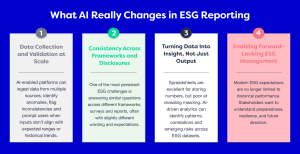
In ESG reporting, AI’s impact is most visible across four critical areas:
1. Data Collection and Validation at Scale: AI-enabled platforms can ingest data from multiple sources, identify anomalies, flag inconsistencies and prompt users when inputs don’t align with expected ranges or historical trends. This dramatically improves data reliability while reducing manual review time.
By the end of 2025, organisations using automated validation tools reported up to 40% fewer data errors compared to spreadsheet-based processes, according to enterprise software benchmarks.
2. Consistency Across Frameworks and Disclosures: One of the most persistent ESG challenges is answering similar questions across different frameworks, surveys and reports, often with slightly different wording and expectations.
AI can recognise overlaps, map disclosures across standards and ensure consistency in responses. This not only reduces duplication but also strengthens credibility by ensuring that narratives align across reports, investor questionnaires and regulatory filings.
3. Turning Data Into Insight, Not Just Output: Spreadsheets are excellent for storing numbers, but poor at revealing meaning. AI-driven analytics can identify patterns, correlations and emerging risks across ESG datasets.
For example, AI can highlight how changes in supplier emissions affect overall climate risk, or how workforce indicators correlate with safety incidents or attrition trends. These insights enable leadership teams to act earlier and more strategically.
4. Enabling Forward-Looking ESG Management: Modern ESG expectations are no longer limited to historical performance. Stakeholders want to understand preparedness, resilience, and future direction.
AI supports scenario analysis, trend forecasting and the testing of assumptions, helping organisations explore how ESG risks and opportunities may evolve under different conditions. This moves ESG reporting from backwards-looking disclosure to forward-looking strategy.
From Reporting Burden to Strategic Capability
Perhaps the most significant shift AI enables is cultural.
When ESG reporting is manual and spreadsheet-driven, it is often perceived as a burden, time-consuming, repetitive and disconnected from business value. When AI automates low-value tasks and enhances insight, ESG becomes a source of intelligence.
Recent research from global investment institutions shows that companies integrating advanced analytics into sustainability reporting are twice as likely to link ESG performance to capital allocation and strategic planning. This signals a clear trend: ESG data is becoming part of core decision-making.
How Rimm Is Supporting the Shift From Spreadsheets to Strategy
At Rimm, we see AI as an enabler of clarity, confidence and control. Our platform is designed to help organisations replace fragmented spreadsheet processes with structured, intelligent ESG management.
By embedding AI into data collection, validation, disclosure mapping and analytics, we help clients reduce reporting risk while increasing strategic value. Teams spend less time reconciling numbers and more time understanding what the data means for performance, resilience and growth.
Across regions and industries, organisations using Rimm are building ESG systems that scale, supporting evolving requirements without reinventing processes every reporting cycle.
What ESG Reporting Looks Like Going Forward
In 2026, the question is no longer whether ESG reporting should be automated, but how intelligently it should be done.
Spreadsheets may still have a role at the margins, but they are no longer the engine of sustainable reporting. AI-enabled platforms are becoming the new foundation, supporting accuracy, insight and strategic alignment.
The organisations that thrive in this environment will be those that treat ESG data not as a static record, but as a living asset, one that informs decisions, builds trust and strengthens long-term value.
At Rimm, we believe the future of ESG reporting lies at the intersection of technology and expertise and that future has already begun. Our team of experts is always ready to support that journey 👉🏾 Reach out today HERE