

In 2026, sustainability teams are facing a more complex reality: alongside expanding disclosure demands, they must also manage the data infrastructure needed to support credible, decision-useful ESG reporting. In this blog, we discuss why ESG reporting is becoming more complex, how organizations are moving beyond manual workflows, and why ESG intelligence platforms, AI, and data infrastructure are becoming essential to effective sustainability management.
ESG reporting expectations continue to grow across markets, even as some rules are being adjusted. The trend points to more accountability and a stronger need for organized, actionable sustainability information. In June 2025, the IFRS Foundation reported that 36 jurisdictions had adopted, used, or were finalizing the introduction of ISSB Standards into their regulatory frameworks. This illustrates how quickly a global disclosure baseline is being established.
At the same time, the burden of reporting is becoming more complicated. Sustainability teams now need to gather, validate, and interpret data from finance, operations, procurement, HR, legal, and supply chain functions. What used to be a periodic reporting exercise is now turning into an ongoing data management challenge.This shift highlights not only the limitations of spreadsheets and manual workflows, but also the growing importance of ESG data infrastructure: the systems, controls, and insights that turn sustainability data into practical, decision-useful information.
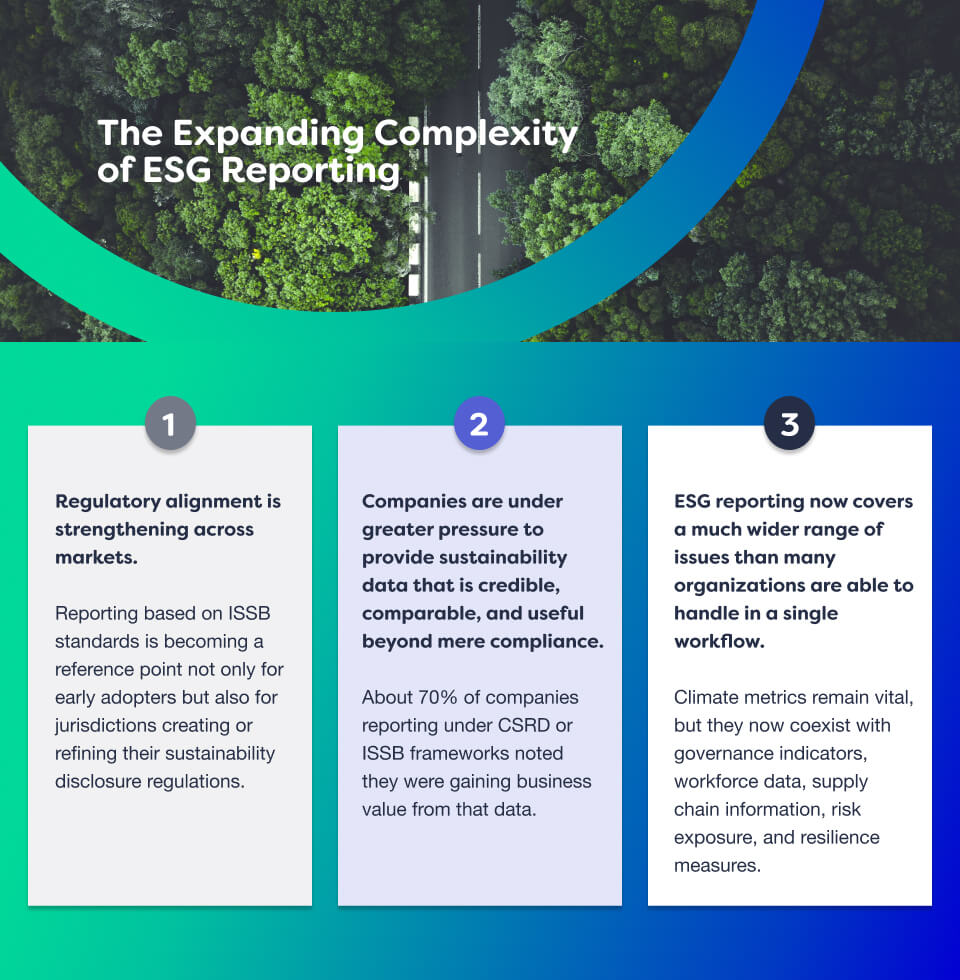
The Expanding Complexity of ESG Reporting
Against a dynamic backdrop, three factors stand out in driving the increasing complexity of ESG reporting: regulation, investor expectations, and the broader scope of the data itself.
First, regulatory alignment is strengthening across markets. Reporting based on ISSB standards is becoming a reference point not only for early adopters but also for jurisdictions creating or refining their sustainability disclosure regulations. The IFRS Foundation’s 2025 jurisdictional update signals that sustainability reporting is progressing toward a more consistent global standard.
Second, companies are under greater pressure to provide sustainability data that is credible, comparable, and useful beyond mere compliance. According to PwC’s 2025 Global Sustainability Reporting Survey, more than half of respondents reported that internal and external pressure to deliver sustainability data and insights increased over the past year. About 70% of companies reporting under CSRD or ISSB frameworks noted they were gaining business value from that data.
Third, ESG reporting now covers a much wider range of issues than many organizations were designed to handle in a single workflow. Climate metrics remain vital, but they now coexist with governance indicators, workforce data, supply chain information, risk exposure, and resilience measures. This creates a reporting environment that is broader, faster-paced, and more interconnected than before.
The Limits of Manual ESG Reporting
When organizations rely on spreadsheets and fragmented manual workflows, handling this level of complexity fast becomes difficult, leading to several governance issues such as:
- Inconsistent data definitions across teams
- Difficulty maintaining version control
- Incomplete evidence trails
- Reporting cycles that are dominated by collecting inputs and reconciling numbers rather than generating insight
Research supports this challenge. KPMG’s ESG reporting and organization research, still widely referenced through 2025, found that many large companies were continuing to depend on spreadsheets for ESG data management even as they prepared for stricter reporting and assurance demands. This gap is significant because as ESG reporting aligns more closely with financial reporting, fragmented and manually pieced-together processes become less viable.
Manual reporting also hinders visibility. When sustainability data is scattered across departments and files, leaders struggle to connect performance, risk, and reporting quickly. ESG becomes reactive, rather than enabling the business to make faster, more informed decisions.
The Rise of ESG Intelligence Platforms
ESG intelligence platforms are becoming increasingly important in this landscape. Their value lies not just in digitizing existing reporting workflows but in helping organizations redesign them.
Modern ESG intelligence platforms create a more controlled environment for collecting, validating, and managing sustainability data throughout the business. They centralize data sources, reduce duplication, and facilitate alignment among sustainability, finance, legal, compliance, and operations around a shared source of information. This is important not only for efficiency but also for consistency and accountability.
When ESG information is centralized and well-governed, teams can move beyond just compiling disclosures and start identifying trends, performance gaps, and emerging risks. Workiva’s 2025 Executive Benchmark Survey found that 97% of executives believe strong sustainability reporting will provide a competitive advantage in two years. Meanwhile, 96% of investors say it enhances financial performance. This indicates that the market increasingly views high-quality sustainability data as strategically valuable, not just a regulatory requirement.
The Role of AI and Data Infrastructure
Technology is speeding up this transition, especially as ESG datasets grow larger and more complex.
AI is already playing a crucial role in sustainability reporting and management. It can assist with data extraction, anomaly detection, validation, framework mapping, and trend analysis. Thomson Reuters’ 2025 Sustainability Reporting Outlook found that almost 90% of respondents expect AI to significantly impact sustainability reporting. PwC’s 2025 Global Sustainability Reporting Survey found that the use of AI for sustainability reporting almost tripled to 28%, up from 11% the previous year, highlighting how quickly AI is becoming embedded in ESG reporting processes.
However, AI is only effective when the underlying systems are robust. Without strong data infrastructure, automation can simply amplify inconsistencies. Organizations require data pipelines, governance models, validation controls, and clearer ownership structures to ensure that ESG information is reliable, auditable, and useful for decision-making.
This shift from reporting to intelligence is fundamentally about infrastructure. While better tools are important, a well-constructed architecture is even more critical.
What This Shift Looks Like in Practice
Across various industries, Rimm’s clients are replacing disjointed spreadsheets with integrated ESG intelligence systems that consolidate sustainability data, automate reporting workflows, and leverage AI-driven analytics to generate actionable insights. This transition helps organizations enhance compliance, improve data transparency, and turn sustainability reporting into a strategic decision-making tool.
Importantly, the benefits extend beyond efficiency alone. Improved ESG systems enable organizations to increase visibility across functions, respond more effectively to regulatory requirements, and make sustainability information more relevant for leadership teams.This enables organizations to improve both compliance and the quality of management decision-making.
Key Takeaways
- ESG reporting complexity is increasing due to expanding disclosure requirements, rising investor expectations, and broadening data scope.
- Manual reporting processes are becoming inadequate since they undermine governance, auditability, and cross-functional visibility.
- AI and automation are growing more critical in ESG management, but they rely on strong data infrastructure to be effective.
- Organizations that find the most value in ESG today are those using sustainability data not only for reporting but also for better business decisions.
ESG reporting is evolving from simply producing compliant outputs at the end of a reporting cycle to becoming an ongoing capability built on data quality, governance, integration, and insight. As requirements continue to change, organizations that invest in ESG intelligence and data infrastructure will be better equipped to handle complexity, respond confidently, and derive greater value from sustainability information.
At Rimm, we believe the future of ESG reporting lies at the intersection of technology and expertise, and that future has already begun.