

At the start of the decade, ESG reporting was often viewed as a necessary obligation, something companies had to do to satisfy investors, regulators or ratings agencies. Reports were produced, metrics were disclosed and the cycle repeated each year. As we progress into 2026, that mindset has changed dramatically. Organisations are discovering that ESG data is far more than a reporting requirement. When structured correctly and analysed effectively, it becomes a powerful management tool, one capable of revealing operational inefficiencies, identifying growth opportunities and strengthening long-term resilience. In other words, ESG is shifting from a disclosure exercise to a business intelligence system. In this blog, we explore how organisations are turning ESG data into tangible business value and what leading companies are doing differently to unlock that impact.
The ESG Value Shift from Compliance to Capability
A defining trend we have continuously seen in 2026 is the transition from ESG compliance to ESG capability. Companies are no longer asking simply “What do we need to report?” Instead, they are asking “What can this data tell us about our business?”
Recent global sustainability surveys released in early 2026 show that organisations integrating ESG metrics into strategic planning are significantly outperforming those treating ESG purely as a reporting function. More than 70% of executives now say ESG insights directly influence investment and operational decisions, while over two-thirds report measurable efficiency gains from sustainability initiatives.
The difference lies in how ESG data is used. When ESG data sits in static reports or disconnected spreadsheets, its value remains limited. But when it is structured, visualised and analysed through intelligent systems, it becomes actionable insight.
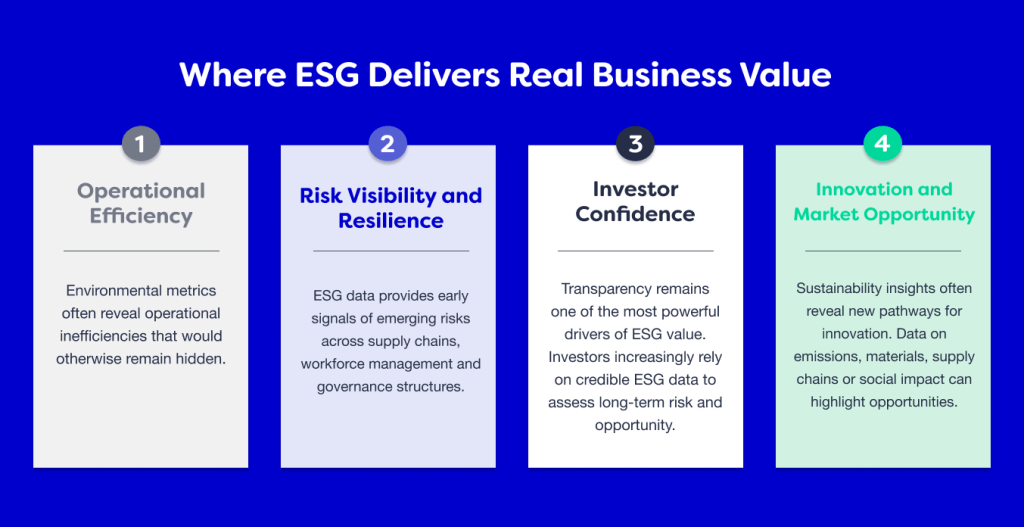
Where ESG Delivers Real Business Value
The organisations leading in ESG maturity today are seeing value across several clear areas of the business. These are the areas where ESG data moves from theory to measurable impact.
1. Operational Efficiency
Environmental metrics often reveal operational inefficiencies that would otherwise remain hidden. Tracking energy consumption, emissions intensity, water usage and waste patterns across facilities allows organisations to identify performance gaps and implement targeted improvements. Many companies now treat sustainability metrics as operational KPIs, similar to productivity or cost indicators. The result is measurable improvement not only in environmental performance but also in cost control and resource efficiency.
2. Risk Visibility and Resilience
ESG data provides early signals of emerging risks across supply chains, workforce management and governance structures. In 2026, organisations increasingly use sustainability data to anticipate disruptions, whether related to climate exposure, labour practices, or regulatory change. By consolidating ESG indicators across operations, leadership teams gain a clearer view of vulnerabilities before they become crises. This proactive approach strengthens organisational resilience and improves strategic planning.
3. Investor Confidence and Capital Access
Transparency remains one of the most powerful drivers of ESG value. Investors increasingly rely on credible ESG data to assess long-term risk and opportunity. Companies that provide consistent, decision-ready disclosures often benefit from stronger investor relationships and improved access to sustainable finance. In 2026, sustainability-linked financing continues to expand globally, with lenders prioritising companies that demonstrate clear ESG governance and measurable performance. Well-structured ESG reporting is therefore not just about transparency; it can directly influence capital allocation.
4. Innovation and Market Opportunity
Sustainability insights often reveal new pathways for innovation. Data on emissions, materials, supply chains or social impact can highlight opportunities to redesign products, improve resource efficiency or develop new services aligned with changing market expectations. Many companies now treat ESG data as a driver of innovation strategy, identifying areas where sustainable solutions can unlock new revenue streams or strengthen brand value.
Technology: The Engine Behind ESG Impact
The ability to unlock these benefits depends heavily on technology. Manual reporting systems and spreadsheets struggle to manage the complexity of modern ESG data. Organisations dealing with hundreds of indicators across multiple business units require systems capable of integrating, validating and analysing data at scale.
In 2026, AI-enabled ESG platforms are increasingly central to this process. These technologies allow organisations to:
- Consolidate ESG data across operations and departments
- Automate validation and reduce reporting errors
- Visualise performance through intuitive dashboards
- Identify trends, risks and improvement opportunities
Instead of producing static reports once a year, companies can now monitor ESG performance continuously and make decisions based on real-time insights.
Lessons from Organisations Leading the Way
Across Rimm’s client network, one pattern is clear: organisations that extract the most value from ESG follow a similar set of principles.
First, they treat ESG as a strategic function, not just a reporting task: Sustainability metrics are integrated into business planning and leadership discussions.
Second, they prioritise data quality and structure: Reliable ESG data is essential for credible insight.
Third, they invest in systems that connect ESG information across the organisation: centralised platforms replace fragmented spreadsheets, enabling consolidated visibility.
Finally, they focus on outcomes rather than outputs: The goal is not simply to produce reports, it is to improve performance.
These organisations are not just meeting stakeholder expectations. They are using ESG intelligence to guide smarter decisions.
How Rimm Helps Turn ESG Data into Business Value
At Rimm, our goal is simple and that is to help organisations move from ESG reporting to ESG performance. Through AI-driven analytics, consolidated reporting tools and intuitive dashboards, our platform enables organisations to transform complex sustainability data into clear, actionable insights. Clients use these insights to identify operational improvements, strengthen governance oversight, track progress toward sustainability targets and communicate performance with confidence. The result is ESG reporting that supports real business outcomes, not just disclosures.
The Next Phase of ESG Leadership
As the second half of 2026 unfolds, the companies leading the sustainability conversation will not necessarily be those producing the longest reports. They will be the ones who turn ESG insights into action.
Organisations that treat ESG data as a strategic asset and integrate it into decision-making, innovation and performance management will build stronger resilience, deeper trust and more sustainable growth.
The shift is clear: ESG reporting is no longer the destination. It is the starting point and the organisations that recognise this are already turning impact into advantage.
If you’re ready to move from ESG complexity to clarity, we’d love to support your journey. Reach out today!